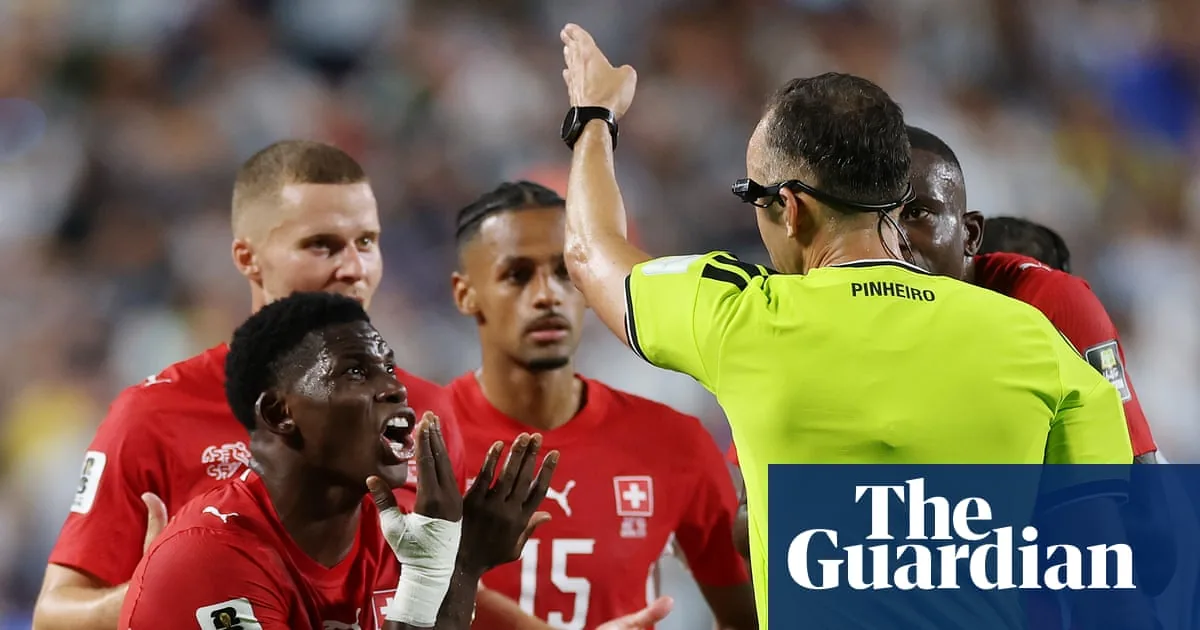
Switzerland forward Breel Embolo became the first player to be sent off under a new mistaken identity rule during the World Cup quarter-final match against Argentina. The incident occurred after Embolo received a second yellow card for simulation, following an initial booking in the first half.
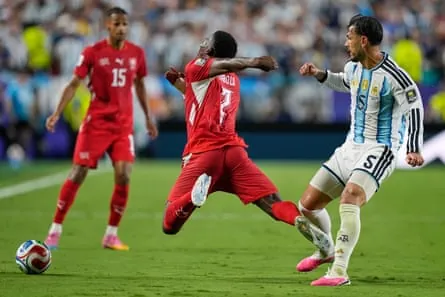
The sequence began when Argentina’s Leandro Paredes was initially cautioned for what appeared to be a clumsy challenge. However, the video assistant referee (VAR) intervened, prompting referee Joao Pinheiro to review the play. Upon review, the official determined that Embolo had simulated a foul.
This decision led to Embolo’s red card, leaving Switzerland with ten men just five minutes after they had scored an equaliser against the defending world champions. Embolo, who plays for French club Rennes, was visibly upset as he left the pitch in Kansas City, being consoled by his teammates.
Controversy surrounding the new rule
Switzerland coach Murat Yakin expressed strong disapproval of the decision and the rule itself. He stated there was no reason for the initial yellow card and described the situation as harmless, suggesting play should have continued. Yakin criticised the rule as unacceptable and having nothing to do with football, asserting that its intervention destroyed his team’s game.
Despite the coach’s sentiments, some pundits offered limited sympathy for Embolo. Former Major League Soccer striker Bradley Wright-Phillips commented that Embolo had potentially cost his team a spot in the semi-finals. Former Jamaica international Jobi McAnuff added that Embolo had let himself and his teammates down, noting that while it was simulation, one could still feel some sympathy for him.
Argentina ultimately secured a 3-1 victory in extra time against the ten-man Swiss side. They are now set to face England in the semi-finals. Yakin, despite the loss, expressed pride in his team’s passion and effort, even when playing with a numerical disadvantage.
The expanded mistaken identity law
The new law, specifically requested by Fifa’s head of referees, Pierluigi Collina, allows for a decision to be changed if a player is booked or sent off but the foul was actually committed by the opposing team. This expansion of the rule by the International Football Association Board for the 2026 World Cup covers situations where an initial booking was made, but the offense was found to have been committed by the other side.
In this instance, if Paredes had not been initially booked, the mistaken identity ruling would not have been applied, and Embolo would have remained on the field. The VAR review for mistaken identity was recommended by Guillermo Pacheco Larios, who observed footage showing Embolo initiating his fall before contact from Paredes.
The offense was consequently reclassified from recklessness by Paredes to simulation by Embolo, both of which carry a yellow card. Since Embolo had already received a yellow card earlier in the match for a foul on Paredes, the second yellow resulted in his ejection.
This marked the second application of this expanded rule in the tournament. The first instance occurred in a match between the United States and Paraguay, where USA defender Tim Ream was initially booked for a foul on Miguel Almiron. The VAR intervened, and after review, it was determined that Almiron had dived, leading to the rescinding of Ream’s yellow card and a caution for Almiron instead.
Switzerland midfielder Remo Freuler echoed his coach’s frustration, questioning the VAR’s intervention in such a situation and its impact on the game. The decision was announced over the stadium’s public address system, leading to celebrations among the predominantly Argentina-supporting crowd at Kansas City Stadium. Embolo’s emotional reaction, surrounded by teammates, underscored the gravity of the call, which Yakin described as a referee mistake that shattered the player.
The expanded definition of “mistaken identity” for VAR reviews has been a point of discussion, especially after its application in the United States’ opening game. The call in the Argentina vs. Switzerland match is expected to face further scrutiny due to its significant impact on the quarter-final outcome, forcing Switzerland to play extra time with a player disadvantage, which contributed to them conceding two goals in nine minutes.
Yakin admitted he was unaware of the specific rule change prior to the match on Saturday.
Source: bbc.com